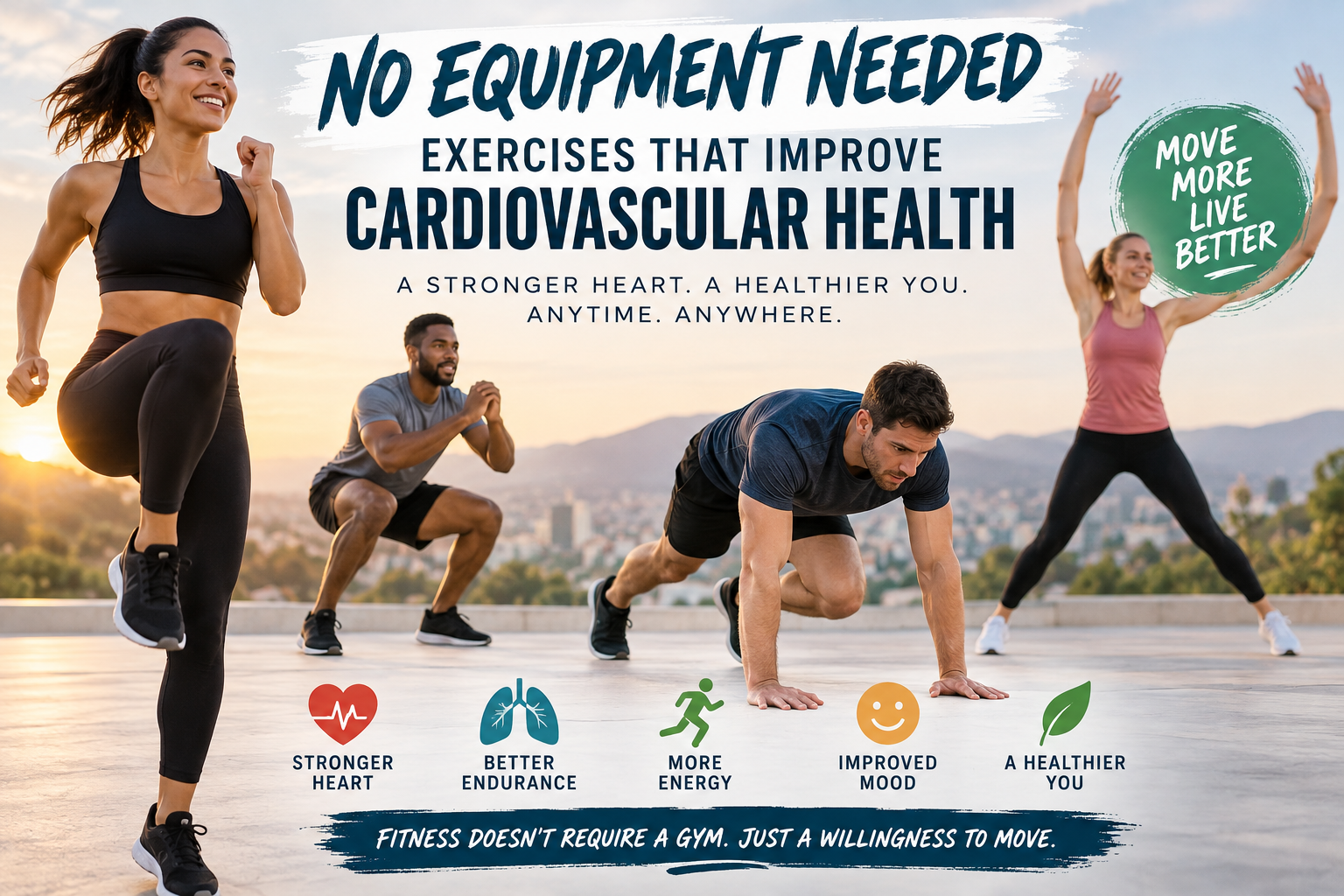
Improving cardiovascular health does not require a treadmill, exercise bike, gym membership, or expensive equipment. Some of the most effective forms of cardio rely on nothing more than your own body weight and enough space to move.
Cardiovascular exercise strengthens the heart and lungs, improves circulation, and helps the body become more efficient at delivering oxygen to working muscles. Done consistently, it can also improve endurance, energy levels, metabolic health, and overall physical conditioning.
The key is not the equipment you use. The key is raising your heart rate for long enough—and often enough—to challenge your cardiovascular system.
1. Brisk Walking
Walking is one of the simplest forms of cardiovascular exercise, but it should not be underestimated.
A relaxed stroll may not raise your heart rate very much, but brisk walking can provide a legitimate aerobic workout. Walk fast enough that your breathing becomes noticeably heavier while you can still speak in short sentences.
You can make walking more challenging by:
- Increasing your pace
- Walking uphill
- Taking stairs
- Extending the duration
- Alternating periods of fast and moderate walking
For people who are beginning to exercise or want a low-impact option, brisk walking is an excellent place to start.
2. Jogging or Running in Place
If you do not have access to a treadmill or suitable running route, simply running in place can elevate your heart rate surprisingly quickly.
Keep your posture upright, move your arms naturally, and land lightly on the balls or middle of your feet.
You can perform it steadily for several minutes or use intervals, such as:
30 seconds of faster running followed by 30–60 seconds of slower movement.
Running in place is also useful when exercising in a small apartment or hotel room.
3. Jumping Jacks
Jumping jacks are a classic cardiovascular exercise because they involve both the upper and lower body.
Performing them continuously can quickly raise your heart rate while also improving coordination and muscular endurance.
Beginners can perform a lower-impact version by stepping one foot out at a time instead of jumping.
Try starting with 30–60 seconds of jumping jacks followed by a short rest before repeating.
4. High Knees
High knees combine running with exaggerated knee elevation.
While jogging in place, drive each knee upward toward your chest while pumping your arms.
Because the movement recruits large muscles in the legs and core, high knees can raise the heart rate rapidly.
They work particularly well during short, intense intervals such as:
20–30 seconds of high knees followed by 30–60 seconds of recovery.
5. Mountain Climbers
Mountain climbers combine cardiovascular conditioning with core and shoulder work.
Begin in a push-up position and alternately drive your knees toward your chest.
The faster you perform the movement, the more demanding it becomes cardiovascularly.
However, speed is not everything. Maintaining stable shoulders and controlled movement is more important than simply moving your legs as fast as possible.
Mountain climbers are especially useful for people who want to combine cardio and muscular conditioning.
6. Bodyweight Squats
Squats are normally thought of as a strength exercise, but performing repeated bodyweight squats can also challenge the cardiovascular system.
Because the thighs and glutes are large muscle groups, repeatedly contracting them requires substantial oxygen and energy.
Try performing 15–30 squats followed by a short recovery period.
For a more intense cardiovascular workout, combine squats with other movements such as jumping jacks or mountain climbers.
7. Squat Jumps
Squat jumps are the explosive version of the bodyweight squat.
Lower yourself into a squat and then jump upward before landing softly and returning into the next repetition.
They can raise the heart rate extremely quickly.
Because jumping places greater stress on the knees, ankles, and hips, squat jumps are better suited to people who already have a reasonable level of conditioning.
A lower-impact alternative is simply performing fast bodyweight squats.
8. Burpees
Few bodyweight exercises raise the heart rate as efficiently as burpees.
A basic burpee involves:
Standing → squatting down → moving into a plank position → returning the feet forward → standing or jumping upward.
Because the exercise moves the entire body through several positions, it can become extremely demanding within a short period.
Beginners can remove the jump or step their legs backward instead of jumping into the plank position.
Even sets of five to ten burpees can provide a significant cardiovascular challenge.
9. Shadow Boxing
Shadow boxing is an excellent form of equipment-free cardio that is sometimes overlooked.
Stand in a fighting stance and continuously throw combinations of punches while moving your feet.
For example:
Jab → cross → hook → step sideways → repeat.
Keeping your hands moving while constantly changing position can raise your heart rate without requiring jumping.
It also develops coordination, rhythm, balance, and shoulder endurance.
Try performing two- or three-minute rounds followed by approximately one minute of rest.
10. Stair Climbing
If you have access to stairs, you already have one of the most effective pieces of cardiovascular equipment available.
Walking or running repeatedly up stairs forces the legs to work against gravity, dramatically increasing cardiovascular demand compared with walking on flat ground.
Beginners can simply walk upstairs and slowly walk back down.
More conditioned individuals can increase the pace or repeat several flights.
Use caution when descending, particularly when fatigued.
11. Dancing
Cardio does not always have to feel like formal exercise.
Putting on music and continuously dancing for 20–30 minutes can provide meaningful cardiovascular activity.
The intensity can range from gentle movement to fast footwork, jumping, and full-body movements.
One major advantage of dancing is that people may remain active longer simply because they enjoy doing it.
Consistency matters more than choosing the theoretically “perfect” exercise.
12. Bear Crawls
Bear crawls challenge the cardiovascular system while also strengthening the shoulders, core, hips, and legs.
Begin on your hands and feet with your knees slightly above the ground. Move forward by coordinating opposite hands and feet.
Even short periods of bear crawling can become physically demanding.
Because they require substantial upper-body involvement, they work well in bodyweight conditioning circuits.
A Simple No-Equipment Cardio Workout
You can combine several of these exercises into a short circuit.
Try:
- 45 seconds jumping jacks
- 45 seconds bodyweight squats
- 45 seconds high knees
- 45 seconds shadow boxing
- 45 seconds mountain climbers
- 60–90 seconds easy walking or rest
Repeat the circuit two to four times depending on your fitness level.
Beginners can reduce each exercise to 20–30 seconds and take longer recovery periods.
More advanced exercisers can shorten the rest periods or increase the duration of each exercise.
Steady Cardio vs. Interval Training
There are two main ways to use these exercises.
Steady-State Cardio
You maintain a moderate effort for a longer period.
Examples include:
- Brisk walking for 30 minutes
- Light jogging for 20 minutes
- Dancing continuously for 30 minutes
This style is useful for building aerobic endurance and can usually be performed relatively frequently.
Interval Training
You alternate harder exercise with easier recovery periods.
For example:
30 seconds high knees followed by 60 seconds walking.
Repeat for 10–20 minutes.
Intervals allow you to reach a higher exercise intensity without maintaining that intensity continuously.
Both approaches can contribute to cardiovascular fitness.
How Much Cardio Should You Do?
General public-health recommendations commonly encourage adults to accumulate roughly 150 minutes of moderate-intensity aerobic activity each week, or about 75 minutes of vigorous activity, with combinations of the two also counting.
However, someone who currently exercises very little does not need to begin there immediately.
Even 10–15 minutes of purposeful cardiovascular activity can be a useful starting point.
Build gradually as your endurance improves.
Pay Attention to Exercise Intensity
You do not necessarily need a heart-rate monitor to judge whether cardio is challenging enough.
A simple method is the talk test.
During moderate exercise, you should generally be able to speak but not comfortably sing.
During vigorous exercise, speaking more than a few words at a time becomes difficult because of heavier breathing.
Your cardiovascular system adapts when it is challenged, but maximum intensity is not required every time you exercise.
Consistency Matters More Than Complexity
One reason people avoid cardiovascular training is the belief that they need special equipment or a gym.
They do not.
Walking, climbing stairs, shadow boxing, dancing, running in place, bodyweight circuits, and other simple movements can all challenge the heart and lungs.
A sophisticated workout performed occasionally is usually less useful than a simple workout performed consistently.
The best cardiovascular exercise is therefore often the one you are willing to keep doing.
Final Thoughts
Improving cardiovascular health can begin almost anywhere.
A living room, bedroom, park, sidewalk, staircase, or hotel room can become a cardio training space.
Start at an intensity appropriate for your current fitness level and gradually increase duration or difficulty as your conditioning improves.
Your heart does not know whether you are using a $5,000 treadmill or doing jumping jacks beside your bed.
It simply responds to the work you ask it to perform.
If you have cardiovascular disease, significant medical conditions, unexplained chest pain, dizziness, or unusual shortness of breath, speak with a qualified healthcare professional before beginning vigorous exercise.

Leave a Reply